
A few months ago, I received some Ooi Ocha Premium Matcha Green Tea as a birthday present. In keeping with the ancient Japanese philosophy of unnecessary packaging, each teabag comes in an individual paper wrapper. I initially just put these in the recycling, but later I noticed the writing on the back wasn’t just the company’s mission statement – it was a haiku, a type of short poem written in three lines and 17 syllables. Once I’d read a couple, I got quite interested in the poems and started to think about how I’d translate them, which ultimately led to me starting this blog.
A bit of background: Ito En, the company that makes my tea, has been running a haiku competition since 1989 and publishes prizewinning entries on their packaging, handily combining two iconic aspects of Japanese culture. Winners are categorised into young children and elementary schoolers (age 12 and under), middle schoolers (age 12-15), high schoolers (age 15-18), adults under 40, and adults over 40. You can even win cash prizes of up to 50,000 yen. There’s also a competition for haiku in English, which does not require that the poems follow the traditional 5-7-5 syllable pattern.
If you are lucky enough to win a prize, what higher honour could there be in the world of poetry than brightening up a faceless desk jockey’s tea break, as they do for me? Not only that, but they’re a nice little translation exercise since they’re short and the syllable pattern gives me a bit of a challenge to work around. Here’s my first attempt.
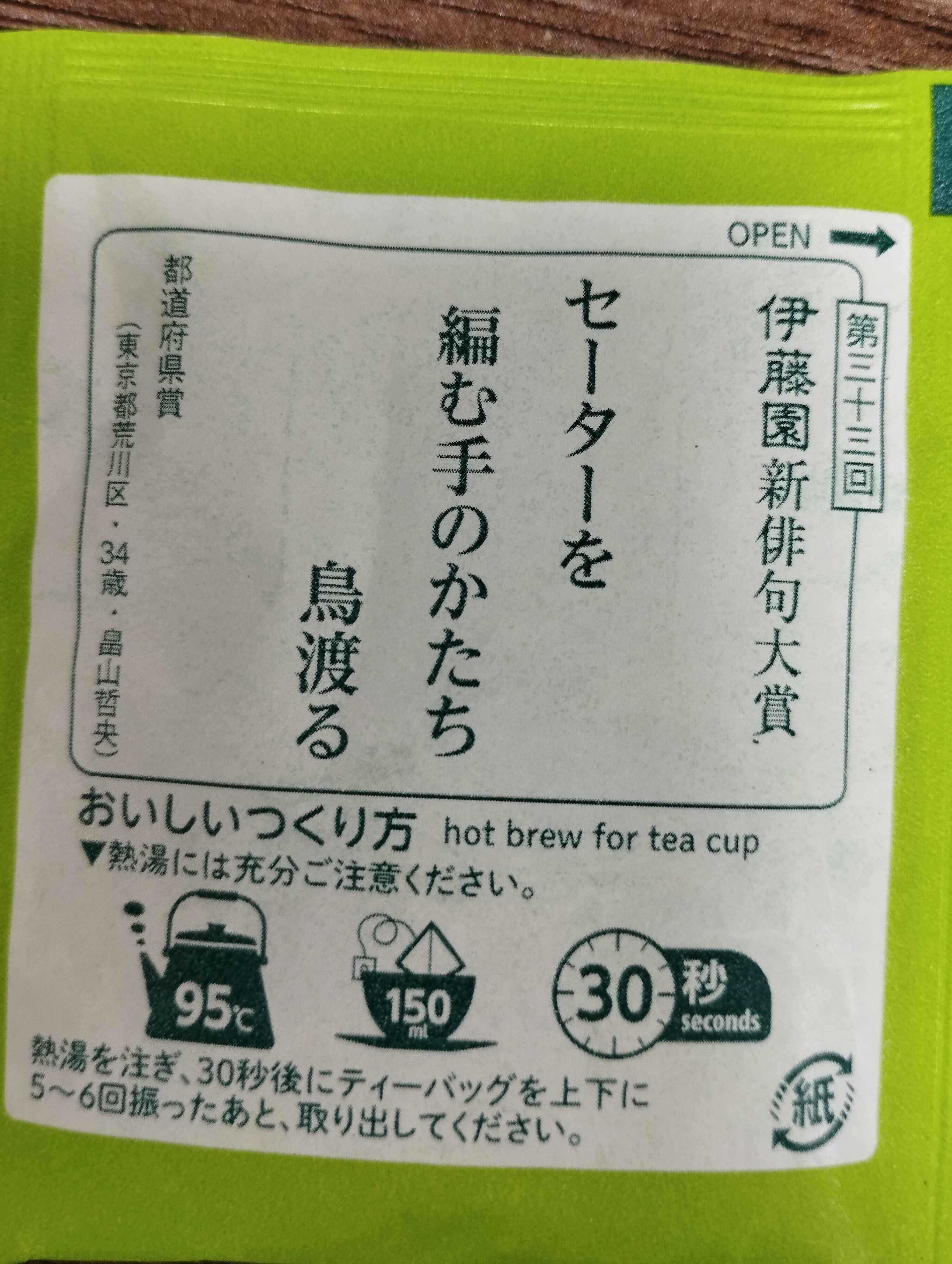
Transliteration:
Sētā o
Amu te no katachi
Tori wataru
English:
Hands that knit sweaters
The same shape as birds flying
South for the winter
33rd Ito En New Haiku Contest
Prefectural Prize Winner
Tetsuo Hatakeyama, age 34, from Arakawa City, Tokyo
As a bird fan and avid knitter myself, it was quite fortuitous that I happened upon this poem. I really like the image of a knitter’s hands as birds in the sky. Perhaps the writer makes this comparison because when somebody knits, their hands and the needles form a sort of M shape and move up and down, similar to how a bird in flight looks from far away. Just as a bird flying high evokes a sense of freedom, knitting gives us the freedom to make our own clothes!
Onto the translation itself – first of all, how to translate かたち (katachi – form; shape; figure) here? I like “shaped like” or “look just like”, but I went for “the same shape as” to preserve the 5-7-5 syllable pattern.
鳥渡る (tori wataru, lit. birds cross over) required a little research. I found that 鳥渡る or 渡り鳥 (wataridori) is an example of 季語 (kigo, lit. season word): a word or phrase in Japanese poetry that’s associated with a particular time of year. In this case, it evokes autumn, as you could probably guess. Maybe kigo are common knowledge in Japan, but I hadn’t come across them before, so I enjoyed reading about all the different ones and what times of year they represent – there’s a list on Wikipedia if you’re interested. Anyway, there’s a couple of possibilities for translating 鳥渡る – “migrating birds” is a bit clunky, and “birds flying south” is a bit vague and too short. I needed to add in “for the winter” to make it clear that they’re migrating, as well as to hit the syllable count.
All in all, a lovely poem and quite straightforward to translate. Thank you very much for reading, and if you enjoyed this post, keep an eye out as I’ll be doing more of these in the future. Comments and constructive critique are always welcome.


 Translation And Chips
Leave a reply to Amy C Cancel reply